Screening Room
Some of the demos and films that changed computing, in order. They all open on YouTube, and most of the machines they show are in my computer museum.

Theseus, the maze-solving mouse 1950s
Claude Shannon · Bell Labs film · about 6 minutes
Claude Shannon, the founder of information theory, built Theseus in 1950 with help from his wife, Betty. A mechanical mouse feels its way through a 25-square maze, and telephone relays under the floor remember the way, so the second run goes straight to the goal. It was one of the first machines that learned by trial and error.

Sketchpad 1963
Ivan Sutherland · MIT Lincoln Laboratory · about 7 minutes
Ivan Sutherland wrote Sketchpad for his PhD thesis. Using a light pen on the TX-2 computer's screen, you could draw shapes, copy them, and set constraints between them. It was an ancestor of computer-aided design and the graphical user interface, and Sutherland received the Turing Award for it in 1988.
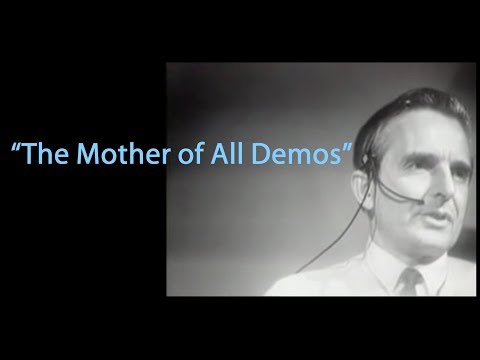
The Mother of All Demos 1968
Douglas Engelbart · SRI · highlights, about 6 minutes
On December 9, 1968, at the Fall Joint Computer Conference in San Francisco, Douglas Engelbart and his team at SRI gave a 90-minute live demo of their oN-Line System (NLS). It was the first public demonstration of the computer mouse, and it also showed windows, hypertext, word processing, video conferencing and real-time collaborative editing.

Xerox Alto commercial 1979
Xerox · Computer History Museum · 1 minute
Xerox's TV ad for its "office of the future." The Alto, first made in 1973 at Xerox PARC, had a mouse, a bitmapped display, windows and Ethernet. It was never sold widely, but after Steve Jobs saw it in December 1979, its ideas went into the Apple Lisa and Macintosh.

UNIX: Making Computers Easier to Use 1982
Bell Labs · Ritchie, Thompson and Kernighan · about 23 minutes
Bell Labs' own film about Unix, with its creators on camera. Brian Kernighan builds a spelling checker live by snapping small programs together with pipes, which is the Unix idea in a nutshell. The system's younger self, V6, is in my museum, and you can boot it in my Time Machine.

Incredible Machine 1968
Bell Labs · AT&T Archives · about 15 minutes
What Bell Labs did with computers when nobody was telling them what computers were for: Ken Knowlton drawing animated films a pixel at a time, Max Mathews composing music on an IBM 7094, and a machine singing “Daisy Bell” in 1961, which is where Arthur C. Clarke got the idea for HAL's last scene. It won a CINE Golden Eagle and sits in MoMA's collection.

The Heralds of Resource Sharing 1972
ARPANET · Internet Archive · about 30 minutes
A documentary about the ARPANET when it was three years old and nobody was sure what it was for. J. C. R. Licklider, Bob Kahn and Leonard Kleinrock explain packet switching to a camera, engineers log in to machines across the country, and somebody demonstrates electronic mail. This is the internet as a research project, filmed before anyone called it that.

Grace Hopper explains the nanosecond 1982
Grace Hopper · National Security Agency · the nanosecond part starts at 40:01
Grace Hopper handed out pieces of wire 11.8 inches (30 cm) long: the distance light travels in a billionth of a second. She used them to show why satellite signals take time to arrive. This full lecture was recorded at the NSA in 1982 and released in 2024, after the National Archives recovered it from old videotapes.

Steve Jobs introduces the Macintosh 1984
Boston Computer Society · January 30, 1984 · Computer History Museum
A week after the Macintosh went on sale on January 24, 1984, Steve Jobs and the Mac team presented it at the Boston Computer Society. Jobs demos the Mac, and then the team that built it, including Andy Hertzfeld, Bill Atkinson and Burrell Smith, answers questions.

Steve Ballmer sells Windows 1.0 1986
Microsoft · Steve Ballmer · 1 minute
Ballmer pitches Windows 1.0 at the top of his lungs, late-night-infomercial style: "How much do you think this advanced operating environment is worth? DON'T ANSWER!" It never actually aired. Microsoft made it as an inside joke to boost morale, and it got out onto the internet years later.

"Dude, you're getting a Dell!" 2000
Dell · Ben Curtis as "Steven" · under 1 minute
The catchphrase of the last few years of beige-box PCs. Ben Curtis played Steven, the surfer-dude sidekick who talked families into mail-ordering Dells across 26 commercials from 2000 to 2003, while direct-order PCs from Dell and Gateway filled every den in America.
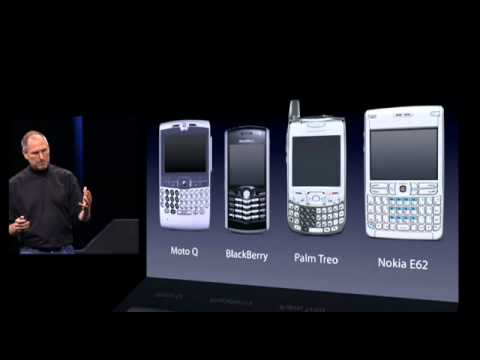
Steve Jobs introduces the iPhone 2007
Macworld San Francisco · January 9, 2007 · about 10 minutes
Jobs said Apple was introducing three products, "a widescreen iPod with touch controls," "a revolutionary mobile phone" and "a breakthrough Internet communicator," then revealed they were all one device. The iPhone had almost no physical buttons and relied on a multi-touch screen. It went on sale on June 29, 2007.
